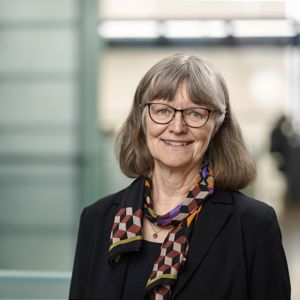
In honor of International Women's Day 2026, we sat down with Nina Smith, who has spent over 44 years doing the research that turns opinion into evidence. With a career dedicated to women's pathways to executive management and boards of directors, Nina is one of Denmark's leading experts at the intersection of labor and education economics. Her work places a particular emphasis on family-friendly policies, women's career progression, and the impact of female leadership on firm performance, alongside research into intergenerational mobility, educational attainment, and the allocation of time within the household. In this interview, she shares what has and hasn't changed for women in the Danish labor market, why she frames gender equality as an economic issue rather than a values debate, and what she believes companies must do differently starting tomorrow.
Who is Nina Smith?
Why did you choose to become an ambassador for SelectionF?
"I have followed SelectionF for many years, and I believe the network does very important work in helping more women succeed in building board careers. It is unfortunate that far too many highly qualified women do not succeed in doing so. It represents a waste of talent and, from a broader perspective, a loss of growth opportunities for Danish companies. That is why I want to support SelectionF’s work."
What has changed the most for women in the Danish labor market since you began your career, and what has surprisingly not changed?
"I entered the labor market in 1981 with a degree in economics. At that time, female economists were truly a rarity. Fortunately, this has changed, and today we see many highly skilled female economists in the media. However, women are still underrepresented in executive management and on boards, particularly across the large group of companies that are not part of the C25 index. And these companies constitute the vast majority of businesses."
Many people talk about gender equality as a values-driven project. You often view it as an economic and socio-economic issue. Why is that distinction important?
"I am an economist and a researcher, and when I speak or act in my role as a researcher, I should not represent my own subjective preferences. Therefore, I emphasize that having more women in leadership also has economic significance. That I personally also consider it a good idea from an equality perspective is another matter."
What advice would you give to an ambitious woman at the beginning of her career that may not necessarily be politically correct but realistic?
"There is a great deal of good advice one could give, and it is certainly needed, because starting a career while also managing children, family, and professional ambitions is not necessarily easy. One important piece of advice is simply to pursue your ambitions. It is possible, and many succeed, but you must expect both victories and setbacks along the way, as well as hard work. If you are prepared for that, it can absolutely be done. You should ignore all the voices that have become so fashionable and outspoken in claiming that women cannot both pursue a career and raise children who thrive. There is absolutely no scientific evidence that this is true. On the contrary, mothers who also succeed professionally may be more inspiring role models for their children and better at teaching them independence and self-reliance. However, if a genuine conflict should arise between children’s well-being and a career, for example in cases of serious illness, there should never be any doubt that family comes first."
If you could change one thing in Danish companies tomorrow that would genuinely advance gender equality, what would it be?
"Most of us will ideally have children, and this typically happens early in our careers. We have now introduced significantly more parental leave for fathers, and I would like politicians to grant fathers even more. This is crucial for changing the career model and career mindset that unconsciously exists in many companies today, namely that early career stages require extremely long working hours to demonstrate leadership potential.
This represents a systemic stumbling block for women as long as they take the majority of parental leave and later most children’s sick days and possibly part-time work. In practice, this means women are systematically pushed off the career track early because it is difficult to follow the traditional “male career model.”
There are, of course, exceptions. But all data show this to be the typical pattern.
Instead, I would like companies to recognize that employees often have children early in their careers, and during that period both parents need more time for family and may not be able to work 60-hour weeks, without this being interpreted as a lack of career ambition. When children grow older and parents move beyond the early childhood years, both women and men can accelerate their careers significantly. If career models were designed this way, many more highly qualified women would have better opportunities compared to the situation today."
A heartfelt thank you to Nina Smith for sharing her time, her research, and her perspective. Her work reminds us that gender equality is not just the right thing to do, it is the smart thing to do. We are proud and grateful to have her as an ambassador for SelectionF.
Happy International Women's Day to all our members, ambassadors, followers, and partners, in Denmark and beyond. Together with SelectionF, we believe that change is possible, one woman and one company at a time. Because when women succeed, businesses grow, families thrive, and society moves forward. Let's keep building that future, together.
/SelectionF